

#094 - Linear Algebra Part 2: Eigenvalues and Eigenvectors
Why Every Structure Already Knows How It Will Fail

This is the second installment of the Linear Algebra series, the first entry is linked below and provides a good overview or refresher depending on your current involvement with the topic.

Every building has a preferred way to move.
It’s encoded in the geometry, the material properties, the mass distribution. When an earthquake hits or wind loads develop, the structure will move in patterns that were predetermined the moment the design is finalized.
Those patterns are eigenvectors. The frequencies at which they amplify are eigenvalues.
Most of us first encounter these terms in a linear algebra course. We solve a few matrix problems, pass the exam, and move on. It’s difficult to internalize their practical meaning without physical intuition to anchor them.
Later, in practice, we run modal analyses in commercial software. We watch mode shapes animate on screen. We note the frequencies. Then we move on.
Somewhere along the way, the mathematical machinery fades into the background. The finite element software absorbs the stomach-turning matrices, and we stop asking what we’re actually computing.
But there is a deeper question worth revisiting:
What is the structure telling us when we solve for eigenvalues and eigenvectors?
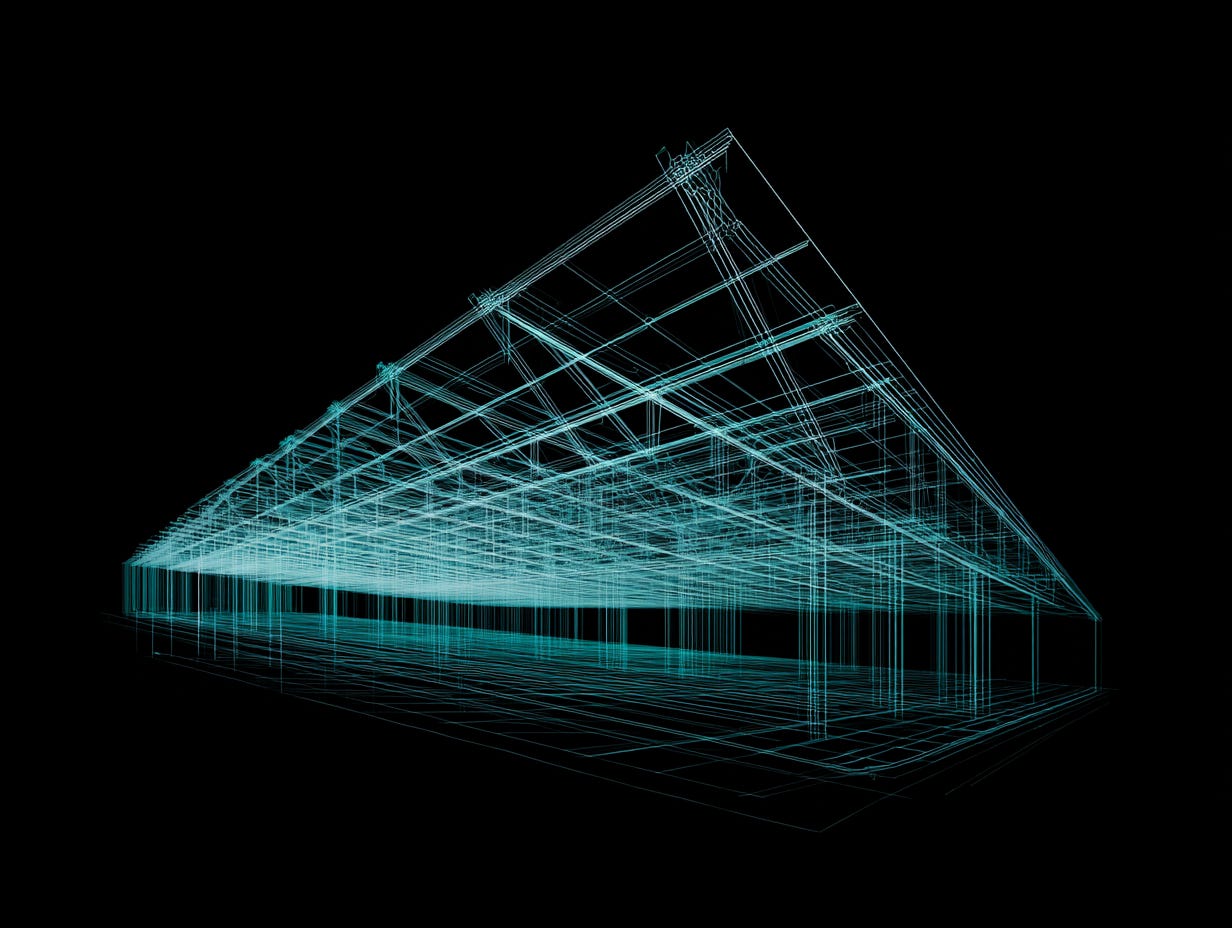
The Question Structures Answer
Consider a simple frame, two columns, a beam. You apply a lateral force. The frame deflects. Remove the force, the frame returns to rest. Standard elastic behavior.
Now apply a dynamic force, shake the base, apply wind, introduce a rotating imbalance. The structure’s response becomes less intuitive. Some frequencies produce large displacements. Others barely register. Certain patterns of deformation emerge repeatedly while others never appear.
This is where eigenanalysis becomes essential. When you assemble the stiffness matrix K and mass matrix M for that frame, you’re encoding all the structural properties into a mathematical object.
Solving the eigenvalue problem, finding values λ (lambda) and vectors ϕ (phi) such that:
which is equivalent to asking the structure a specific question:
“Show me the configurations where you naturally want to oscillate. Tell me the frequencies at which small inputs produce large outputs.”
The eigenvalues give you the frequencies.
The eigenvectors give you the shapes, the spatial patterns of deformation associated with each frequency.
This isn’t imposed on the structure from outside. It’s inherent. A different structure (i.e. change a column size, adjust the bay spacing) produces different eigenvalues and eigenvectors. The mathematics is revealing something that already exists in the physical system.
Why This Matters: Resonance Isn’t Mysterious
Resonance is often treated as something almost mystical. We know it’s dangerous. We’ve seen footage of the Tacoma Narrows bridge. We design to avoid it.
But mechanically, resonance is straightforward.
It occurs when an external forcing frequency aligns with an eigenvalue. The structure is being excited in sync with one of its natural modes. Energy accumulates instead of dissipating. Displacements grow.
The reason this is predictable, the reason we can design against it, is because eigenvalues tell us exactly where the danger zones are before we build anything. Modal analysis isn’t some approximation or rule of thumb. It’s a direct calculation of the structure’s fundamental properties.
Compression of Complexity
Here’s where eigenanalysis becomes genuinely powerful: it compresses massive complexity into a handful of essential patterns.
A moderately detailed structural model might have 10,000 degrees of freedom (DOFs). Solving the transient response, how the structure moves over time under dynamic loading, directly in that full coordinate system is computationally expensive and conceptually opaque.
But if you solve the eigenvalue problem first, you extract maybe 20-30 dominant modes. Most of the structure’s dynamic behavior is captured in those first few eigenvectors. The rest contribute negligibly.
By projecting the problem into this reduced basis (the eigenspace) you transform a massive system into a handful of independent oscillators. You solve each one separately, then recombine the results.
This is modal superposition.
It works because eigenvectors are orthogonal. They represent independent directions in the system’s configuration space. The structure has already done the filtering for you. It’s effectively saying:
“These are my fundamental patterns.
Everything else is just a combination of these.”
What Buckling and Vibration Share
There’s another insight worth drawing out. Eigenvalue problems appear throughout structural mechanics in forms that initially seem unrelated.
Buckling analysis is an eigenvalue problem. You’re solving:
where K_g is the geometric stiffness matrix. The eigenvalue lambda (λ) represents the load factor at which buckling occurs. The eigenvector is the buckled shape.
The Buckling Question: “At what load level does this structure lose its current equilibrium configuration and adopt a new one?”
The Dynamic Question: “What are the structure’s natural oscillation patterns?”
Both are identifying special configurations, points where the system’s behavior fundamentally changes. In buckling, it’s a stability threshold. In dynamics, it’s a resonance frequency. But the mathematical structure is the same.
Understanding this connection deepens intuition. P-Delta effects, cable vibration, plate stability, these topics do not require separate mental models. They’re all eigenvalue problems.
They’re all asking variations of the same question:
“Where do small inputs produce disproportionate outputs?”
The Practical Implication
None of this changes your immediate workflow. You’ll still run the same analyses, check the same code provisions, iterate on member sizes.
When you understand that modal analysis is extracting fundamental properties, not approximating or estimating, but revealing what’s already there, your engineering judgment sharpens a little.
You start asking better questions. Why did that mode show up? What aspect of the geometry or mass distribution is driving it? If I stiffen this connection, which eigenvalue will shift?
You’re no longer a blind consumer of software outputs. You can begin to interrogate the structure’s intrinsic behavior. Many of us do this anyway but you can make a little more technical sense of it.
This is what mathematical understanding provides: not the ability to solve problems by hand (though that has value), but the capacity to interpret what the mathematics is telling you about physical reality.
Where This Leads
The eigenvalue problem is a pattern-extraction tool. It appears in structural dynamics because structures have patterns. It appears in stability analysis because instability has a pattern.
Mathematics doesn’t create these patterns. It reveals them.
When you solved eigenvector problems in linear algebra, you were learning a technique. When you apply it to a real structure, you’re having a conversation. The structure tells you how it wants to move, where it’s vulnerable, what excites it.
This is why revisiting the mathematical underpinnings of our profession is worth the effort. Not as an academic exercise, but as a way to sharpen intuition and improve decision-making. When the theory clicks, the software output stops being numbers and animations and starts becoming insight.
There’s real leverage here, and it’s often overlooked.
I’d be interested to hear how others have developed intuition around modal behavior and stability in practice.
See you in the next one.
James 🌊